



Hi Readers,
I hope you are doing ok! This week I spent some time doing in-person sex ed lessons with high school boys, which is both funny and fascinating, as I explained in this essay for The American Institute of Boys and Men.
At the same time, I started hearing a lot of reactions from people online who had watched the new Neflix documentary Louis Theroux: Inside the Manosphere. I’ve linked to some of most interesting takes at the end of this post, but I don’t feel like I need to add to the alarm about the influencers trying to reach our boys. Instead, I want to focus on solutions.


Talk To Your Boys
It seems like a good time to remind you that Joanna Schroeder and I recently wrote a book, Talk To Your Boys, for people worried about their boys being pulled in by unsavory influencers.
In many ways, this book began way back in 2019, when Joanna looked over her son’s shoulder at his social media feed and grew alarmed at what she saw. She chronicled this experience in a viral New York Times essay: “Racists Are Recruiting. Watch Your White Sons.” She was one of the first to recognize how extremist content was starting to slip into mainstream apps, and she wanted to help parents see what was happening so they could intervene.
In Talk To Your Boys, we help parents navigate lots of awkward conversations, about things like consent, guns, pornography, and substance use. We don’t spend too much time describing the problems - Netflix specials and books like Ruth Whippman’s wonderful BoyMom do a good job of that - but instead focus on practical advice, conversation scripts, and tips for staying connected during challenging talks.

Learn How The Manosphere Is Reaching Boys
Recently, Common Sense Media asked me to work with them on a research project to understand what teen boys’ digital lives are really like. This included creating a large national survey of boys about their experiences online - how they spend their time, what they look at, and how it influences them. Here are the top line findings:
Adolescent boys live and connect online, with 94 percent using social media or playing online games daily. For more than half of boys, digital platforms and gaming make them feel like they belong.
Influencers have emerged as significant sources of guidance and emotional support for adolescent boys. Sixty percent of boys find influencers inspirational, and 56 percent report receiving practical advice from them.
Algorithms, not user intent, are the primary driver of boys’ exposure to posts about masculinity. 68 percent of boys who see such material online say it started showing up in their feed without them searching for it.
While most boys find a sense of belonging in gaming, 70 percent observe bullying or harassment and more than half hear racist, homophobic, or misogynistic language.
Ninety-one percent of boys encounter body image messages online, with three-quarters of boys exposed to online material about being muscular.
Over two-thirds of adolescent boys (69%) regularly see masculinity content that promotes problematic gender stereotypes. This includes messages that girls only want to date certain types of guys (28%), that girls use their looks to get what they want (25%), that boys are treated unfairly compared to girls (12%), or that girls should focus on home and family (12%). Boys with high exposure to this material are significantly more likely to feel lonely, suppress their emotions, and avoid vulnerability. Nearly half of boys believe they must follow “unwritten rules,” like not crying or showing fear, to avoid being teased or picked on.
Find Better Influencers
There’s no reason we have to let toxic bros rule the internet. Check out some of the people trying to spread more positive messages:
Luke Bateman - (also on Substack: Luke Bateman)
Dustin Pace (also on Substack: Dustin Pace)
Ashanti Branch (also on Substack: Ashanti Branch)
Jonathan Jacobs (also on Substack: Jonathan Jacobs)
Jeremy Mohler (also on Substack: Jeremy Mohler)
Richard V. Reeves (also on Substack: Richard V Reeves)
Mark Greene (also on Substack: Mark Greene)
Jackson Katz (also on Substack: Jackson Katz)
Andrew Bernie Bernard (also on Substack: Andrew 'Bernie' Bernard)
The Speech Prof (also on Substack Professor Chesko)
Organizations I recommend checking out include Equimundo, Next Gen Men, Young Men Research Initiative, Partnership for Male Youth, A Call To Men, American Institute For Boys and Men, and Boys & Men Online
Five Takes On “Inside The Manosphere”
Here are some reflections on “Louis Theroux: Inside the Manosphere” I think are worth your time:
Who Are The Young Men ‘Inside the Manosphere?’
The Netflix documentary devoted ample time to the influencers themselves, but too little to the young men who watch them.
By Young Men Research Initiative, Equimundo, and Charlie SabgirBoots On Their Necks
Why is the toxic manosphere so obsessed with breaking the spirits of men?
By Jonathan JacobsOne Weird Trick for Being a Better Man
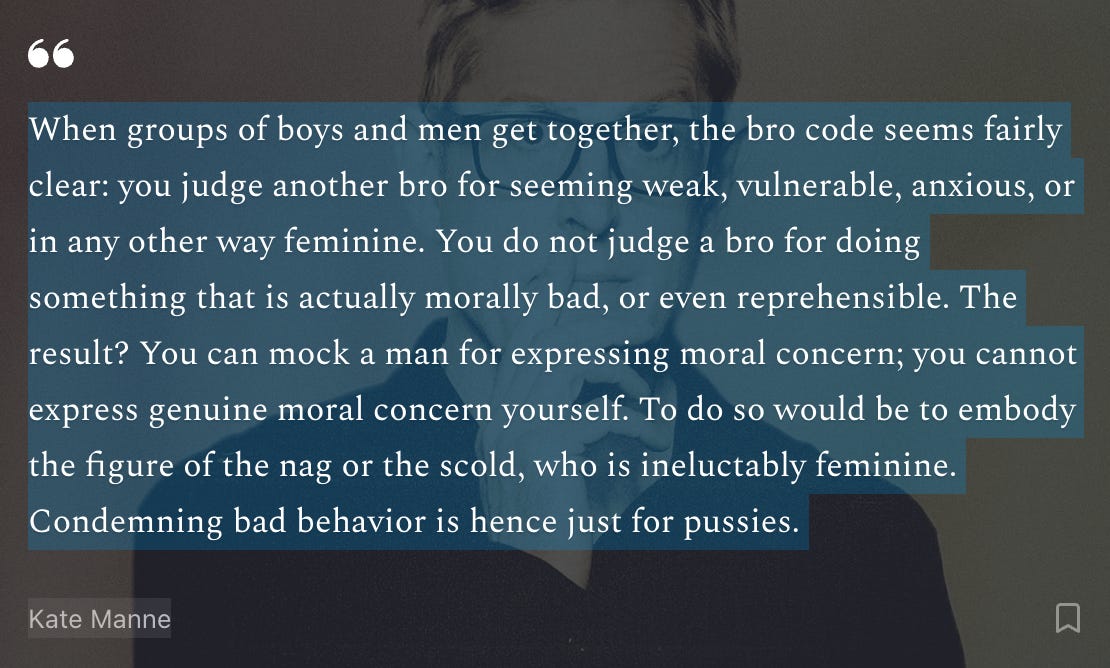
When a man is with other men, why does he lose his moral compass so reliably?
By Kate ManneWhat the Manosphere, Locker Room Talk, and the Epstein Files Have in Common
The Manosphere is Just an MLM
And your kitchen table is the antidote.

Talking It All Out
Here’s a video of my conversation with Dana DuBois and Lawrence Winnerman on The Daily Whatever Show. Dana’s essay “Middle-Aged Men Keep Ogling My 16-Year-Old“ had just gone live, and our discussion was essentially the other side of that story—helping the adults in boys’ lives raise kids who don’t become the men in Dana’s essay. We talked about how to actually have hard conversations with teenagers, why screen time’s bigger problem is what it’s replacing, and the radical idea that staying close to your kid matters more than any single talk. I also got to talk about Fugazi!
Great piece- and thank you for the shoutout for Boymom…
I have issues with terms like "manosphere," "toxic masculinity" or even "mansplaining" because these terms are often used in a way to discount discussions that are necessary, essentially by prejudgement. This statement in the piece is an example of prejudgement that can stifle needed conversations, particularly with young men, in order to protect another unstated agenda:
"Over two-thirds of adolescent boys (69%) regularly see masculinity content that promotes problematic gender stereotypes. This includes messages that girls only want to date certain types of guys (28%), that girls use their looks to get what they want (25%), that boys are treated unfairly compared to girls (12%), or that girls should focus on home and family (12%)."
When boys experience things like "girls only want to date certain types of guys" – well that's partly true SOME girls have a preference for certain types of guys, and all girls have some preferences at some level (just as boys do) – how are boys able to navigate their own sense of self in a world where there are qualities that are valued, or devalued by potential dating prospects, if the very topic is considered "problematic." Some women do on occasion use their gender to advantage (just as men do) – one can't have a nuanced discussion of privilege (and in some areas, such as detention, girls do have an advantage) if the very discussion is seen as problematic to begin with. In some areas boys are treated unfairly when compared to girls, but I would use the term systematically disadvantaged instead treated unfairly – are we not to have this discussion either? And the question 12% being exposed to the idea of girls needing to focus on home and family is an ongoing societal discussion (one that I don't agree with and would equally like to see more discussion of how boys integrate to focus on home and family as adults) – but saying the topic itself is problematic, without allowing for the conversations, is a lot like saying we can't talk about policy in Israel because it is antisemitic to do so.
None of these topics, in and of themselves, necessarily indicate "problematic gender stereotypes" it is the context that makes them damaging, or not. I would not be surprised that many boys have real life experiences of when a boy was treated unfairly compared to a girl (just as girls have had the opposite experience). Are we to say that these topics are blankety forbidden for discussion? These topics are not wrong, but the context of the conversations on line are. The solution is not to say to boys, "if you talk about these topics you are exhibiting "problematic gender stereotypes."" Boys already feel marginalized and are checking out... hence the gravity to online platforms where they feel more supported. Terms like "problematic gender stereotypes," "manosphere," "toxic masculinity" or even "mansplaining" are terms that only push boys (and men) farther away. We can't have respectful conversations with boys and men on the problems the feel deeply about, but have trouble articulating, if we ourselves can't model that respect first and provide a language that recognizes their experiences as as being real and important to us, not something to just call a name and dismiss.