


Hi Friends,
The United States is celebrating its 250th birthday this week. American readers, in addition to joining joyous “Take Me Home, Country Roads” sing-a-longs (which you should definitely do!), I would love to encourage you to think about the kind of country you want to live in, the values that are important to you, and how you’d like us to treat immigrants and refugees.
Seeing the wonderful mix of people visiting North America as part of the World Cup actually provides a great opening for this kind of talk. I’ve written up some questions for reflection in this post - feel free to bring these up with your friends and family, or just think about them for yourself.
Big love,
Christopher

Reclaiming The ‘Best Thing About America’
Recently, New York Times columnist Michelle Goldberg made the case that America should proud to be a land of immigrants:
“I just think it’s the best thing about America, quite simply. It’s the thing that we have historically done better than others. We absorb immigrants. We integrate immigrants. I still am very sentimental about the Emma Lazarus poem on the Statue of Liberty. Historically, we’ve gone through these periods of racial nationalism like we’re in right now, where people want to define America as an ethnic community, and periods of civic nationalism where America is about ideas and values that are open to anyone who is willing to do the work of embracing them.”
I think we all should be having big, broad conversations about immigration, and as a high school teacher of course I’d love to see teenagers participating in those discussions. Here are some prompts to get you started:
Big Questions To Consider
How hard do you think it should be for people to come to the U.S. to work?
How hard do you think it should be for people to become U.S. citizens?
How welcoming do you think we should be to people who are fleeing war or violence?
How welcoming do you think we should be to people who say they want better economic opportunities for themselves and their families?
How big of a priority do you think border and immigration enforcement should be in the federal budget?
Do you think we should give amnesty to undocumented people who are already living in the United States, like Ronald Reagan did in 1986, or lay out some other pathway to citizenship?
Do you think we should provide specific protections for people who were brought to the U.S. as children, like Deferred Action for Childhood Arrivals (DACA)?
Canada welcomes three times more immigrants on a per capita basis than then the U.S. Do you see anything in Canada’s immigration policies and goals that you think the U.S. should adopt?
Want More To Think About?
Listen to this special epiode of KALW’s “Notes From The Edge” about America at 250. Here’s how host Jeff Chang describes it:
“We speak to the New York Times columnist (and Charlottesville resident) Jamelle Bouie, one of our leading voices on how history finds its way into our present-day politics and culture. We also speak to Paul Farber, the co-founder of Monument Lab, someone who has thought a lot about monuments, memory, and public space.
And in a segment we’re calling Music Notes, we pose the question — what is your ideal national anthem? — to three of our favorite artists: the musicians Leyla McCalla and La Doña and the film director, author, and multihyphenate artist Julian Brave NoiseCat.”
What I Learned From Visiting Ellis Island
History teacher Jenna Vandenberg recently wrote about the hope she found in a visit to Ellis Island:
Once upon a not-so-long-ago time, the USA quickly and efficiently processed millions of immigrants. Ellis Island processed 12 million immigrants between 1892 and 1954. Over a million entered the United States in 1907 alone. Most immigrants arriving at Ellis Island were processed in a few hours. No passports, visas, or papers were needed to enter the United States through Ellis Island.2 For most people, getting through Ellis Island took only about 3 - 5 hours. And then they were off to their new lives in America.
When I tell this to my students, many of whom have helped their families sort through piles of immigration paperwork, their mouths drop open in flabbergastment.3
Those who say things like “immigrants today need to follow the rules, just like my ancestors did,” generally have no idea what they are talking about.
I’ve been to Ellis Island myself, and paid particular attention the exhibit on Norway, where I took this photo:
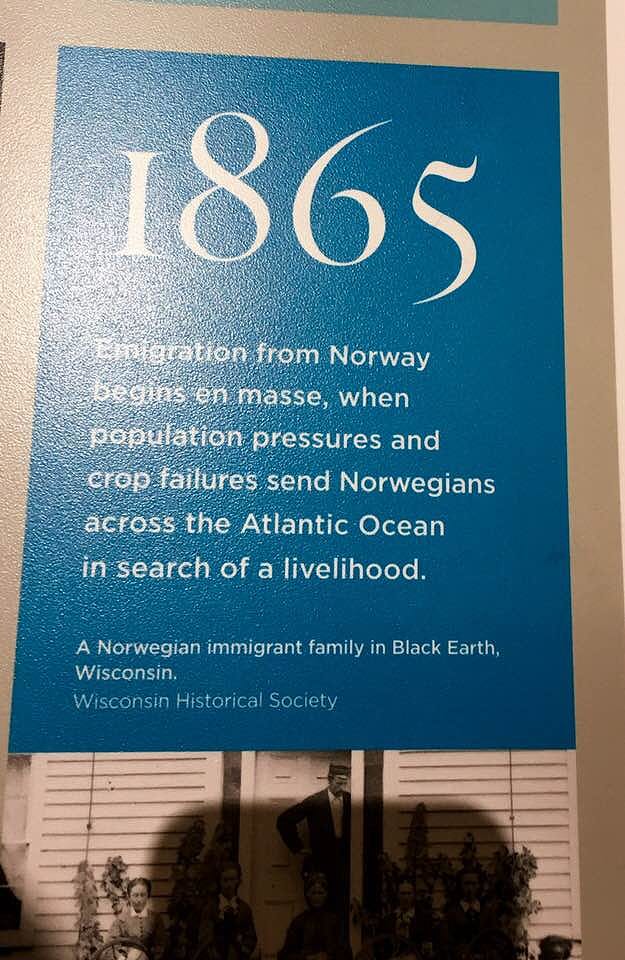
My family roots are in Norway. In the 1800s, things were pretty rough there, and like a lot of Norwegians, they came to the U.S. to escape poverty and famine, with hopes for a better life.
Even back then, immigration didn’t sit well with everyone in the U.S., according to this Washington Post story:
“For the vast majority of their shared history, including the period in the mid- to late 1800s and early 1900s that comprised the biggest wave of immigration to the United States, Norway might have been on the president’s so-called manure pile.
European immigrants of that time fueled many of the same fears about immigration we see today, and politicians fought to close the nation’s borders back then as successive waves of migrants from different European countries faced hostility upon arrival in the United States.
Today, those immigrants are idealized as a fast-assimilating group that came over with nothing but the shirts on their backs, and handed their children the American Dream. Some place them in sharp contrast to what they see as the insular communities of present-day immigrants such as those called out by the president. But it only appears that those migrants assimilated quickly because past economists only looked at a moment in time, instead of following individuals throughout their lives.”Despite the challenges, I am so grateful that the United States made room for my ancestors, and made it possible for us to build a life here.
I appreciate the many immigrants who help make my community vibrant and wonderful, and I want our country to keep making space for newcomers and refugees. Warmly welcoming people who want to come here seems a lot more likely to produce a positive, bright future for our country than walls, bans, or raids.
What do you think? Share your thoughts in the comments.
Recent Teen Health Today Highlights
The Cast Of “This Is Us” Shares Our Parenting Advice
How “acting like a cat” may help you connect with teens
Should Parents Be Tracking Their 18- to 25-Year-Old Kids On Their Smartphones?
Navigating the line between safety and autonomy. PLUS: A deep dive into Andrew Tate’s “empire of abuse,” and a look at who is fighting to keep Kratom legal.
I’ve Worked At The Same Place For 24 Years. Today Is My Last Day.
Ch-Ch-Ch-Ch-Changes
Pimples, Boobs, And Body Hair: On This Podcast, Teens Help Younger Kids Understand Puberty
Kids have LOTS of questions about puberty. The teens on Brains On: Puberty give them real answers.