


Hi Readers!
When Joanna Schroeder and I sat down to plan our book Talk To Your Boys, it became clear pretty early that we would need to have a chapter on boys and school. In that chapter, we explore why so many boys struggle with or actively dislike school, and we take a look at the steps some schools have taken to become more “boy friendly.” I also share what I’ve learned from running Young Men’s Health Groups in San Francisco schools, and why I think every school should have a boys’ group that helps boys connect with one another and express their emotions.
Since the book came out, I’ve been getting a lot of calls from schools to talk to teachers, parents, and students - people are recognizing that boys need some extra help right now, and they are reaching out for support. I’m so grateful!
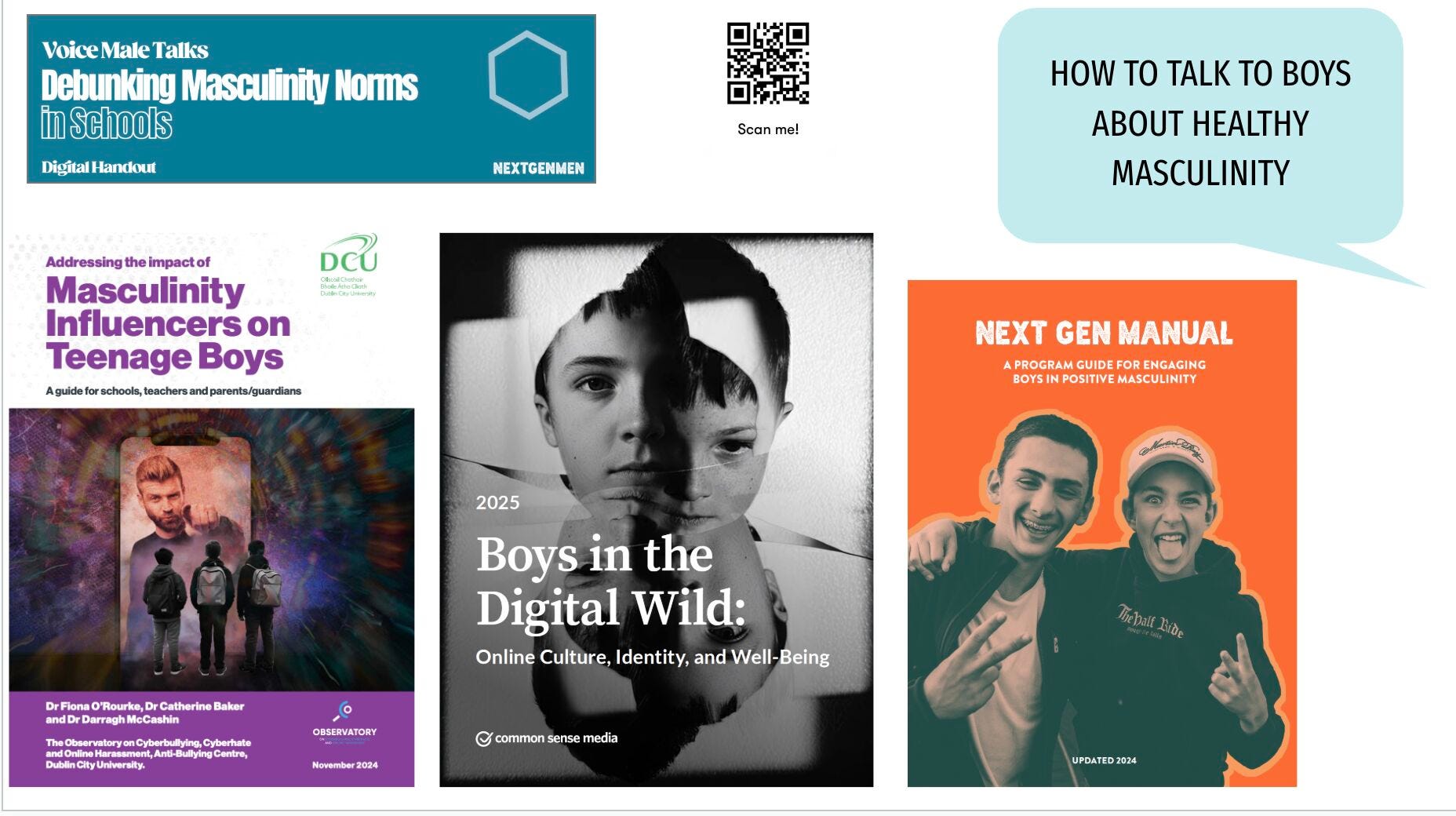
I’ve also been thrilled to hear from people who are using resources I share to spur conversations in in their own communies.
One example comes from Rae Merrigan, a teacher in Jakarta, Indonesia, who reports in from the recent PHASE Asia Pacific conference in Singapore: “We used the Common Sense Media report along with the resources from your articles and talks, and the Next Gen Men guide to help us discuss how we can create safe spaces for boys in schools to connect with role models and discuss what masculinity means to them. I’m hoping to get a boys group started in my school soon!”
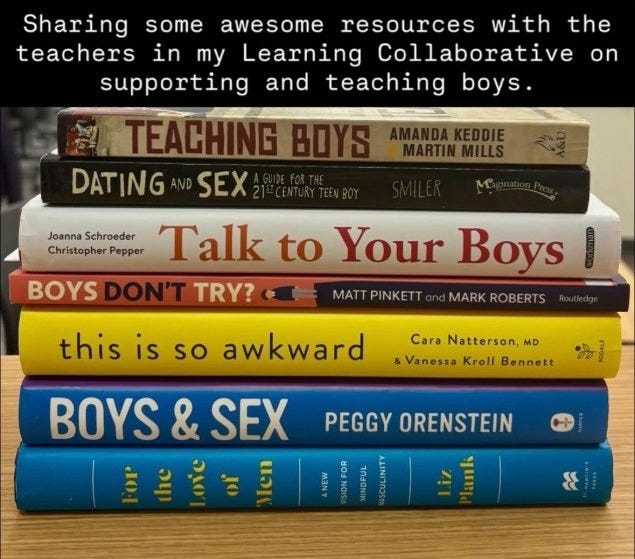
Another example come from former National Health Education Teacher of the Year Andy Milne. He responded to a “call to action” I made during a conference presentation on boys a few years ago by jumping into action in a real way. He’s now in his second year leading a study group for educators in his Illinois school on teaching and supporting boys.
I think this issue of boys and school is super important, and I hope we keep finding new ways to discuss it. In this edition of Teen Health Today, I’m sharing three videos that all have something to do with boys and school, but they are quite different in their approaches and perspectives. I hope will get you thinking, talking, and connecting.
Big Love,
Christopher

Debunking Masculinity Norms In Schools
Voice Male Talks: Debunking Masculinity Norms in Schools is a conversation about challenging harmful masculinity norms in the classroom and equipping educators with the tools to do so.
Despite progress toward gender equality, harmful gender norms continue to shape young people’s lives. For boys, these norms force them into a narrow, tough, emotionless mold that isolates them, harms their mental health, and increases rates of violence. Boys who don’t conform face ridicule, rejection, and punishment, further reinforcing the power dynamics that fuel gender-based violence.
With students spending hours each day in school, educators play a crucial role in challenging gender norms. They have the opportunity to foster critical thinking about masculinity stereotypes, creating environments where boys can flourish as their authentic selves, and celebrate the individuality of their peers across the gender spectrum.
Listen to this March 2025 conversation, where I join experts from Canada and the UK to explore why this topic matters and share strategies for fostering more inclusive, safer, and gender-equitable learning environments by working with boys to debunk gender norms.
We take on tough, urgent questions, such as:
How can educators engage boys who strongly embrace restrictive ideas about masculinity?
How do you navigate resistance when boys feel defensive or disengaged?
And how do we address misogyny in the classroom without alienating students who have internalized patriarchal beliefs?
By watching, you’ll gain the skills to challenge harmful masculinity norms in the classroom, and empower boys to break free from stereotypes, embrace their authentic selves, and help break cycles of violence.
50 Years Later, Men Reflect On Their School Experience
“Fortunate Sons” is an extraordinary feature-length documentary focuses on the 1974 graduating class of the Harvard School for Boys, then a private military school for the sons of the Los Angeles elite. Born into privilege and groomed to lead, they entered 7th grade at this all-male military school in the cultural watershed year of 1968. An American journey about friendship, life, loss, and redemption – culminating with the class’ 50th reunion in 2024 – it resonates powerfully with the developing national conversation about the mental health of boys and men, the evolution of masculinity, and the power of connection and vulnerability.
The film is currently available to stream for free on pbs.org and the PBS App, available on iPhone, Apple TV, Android TV, Android smartphones, Amazon Fire TV, Amazon Fire Tablet, Roku, Samsung Smart TV, and Vizio.
How Do I Stop My Son From Becoming Sexist?
In this episode of the Ask Lisa podcast, psychologist Dr. Lisa Damour and journalist Reena Ninan unpack what’s really going on developmentally for boys in early adolescence, and how parents can respond with empathy and understanding instead of fear or frustration. You’ll learn why boys often struggle more in school at this age, how their neurological growth differs from girls’, and what you can do to protect your son’s confidence and values as he grows into himself.
Listen to learn:
Why seventh-grade boys face unique biological and neurological challenges
How school environments can unintentionally favor girls’ developmental strengths
How figures like Andrew Tate prey on boys’ vulnerability, and what parents can do about it
How to keep communication open and help boys find confidence in healthy ways
This episode is a must-watch for any parent of a tween or teen boy who wants to understand what’s really happening beneath the surface — and how to support his growth with empathy and confidence.
BONUS: Dr. Lisa Damour and I have had several public conversations over the last two years. Catch up here:
Ask Lisa: Talk to Your Boys: Raising Confident, Caring Young Men
Teen Health Today: Dr. Lisa Damour: How To Use “Inside Out 2” To Kickstart Conversations With: Kids
Aspen Ideas - Health: Anxious Girls, Lonely Boys Panel
Common Sense Media: Living with Teens and Social Media
Common Sense Media: Toxic Online Culture: Unpacking the Influence of Social Media, Memes, Gaming (and More)
If you enjoyed this post, please forward it to someone else who might like it, and click the ❤️ or 🔁 button on this post so more people can discover it on Substack. 🙏🏼
I am deeply skeptical of your approach. It's basically anti-boy, regressive and decadent. You aren't interested in boys, you are interested in boys as tools for girls. You want grass-eating, lotus eaters, in a chthonich, orphic, decaying civilization, that kills freedom, ideas, creativity, adventure.
(by the way, research shows that feminized school teachers grade boys unfairly)