


Hi Readers,
When I got home from work yesterday, I caught this news report about kids in Minnesota being taken into custody by ICE, and then another story from the same school district that spelled out this detail:
”Masked agents apprehended 5-year-old Liam Conejo Ramos in his driveway on Tuesday as he returned home from school with his father,” Zena Stenvik, the Columbia Heights superintendent, said.
“Another adult living in the home was outside and begged the agents to let him take care of the small child, and was refused,” Stenvik said. “Instead, the agent took the child out of the still-running car, led him to the door and directed him to knock on the door asking to be let in in order to see if anyone else was home, essentially using a 5-year-old as bait.”
In addition to that chilling story, Superintendent Stenvik said that a 17-year-old high school student who was traveling to school was snatched up by armed agents.
These pieces hit me hard, especially since I’d spent a good part of my workday yesterday visiting high schools in San Francisco, and seeing the heightened awareness of ICE all around.
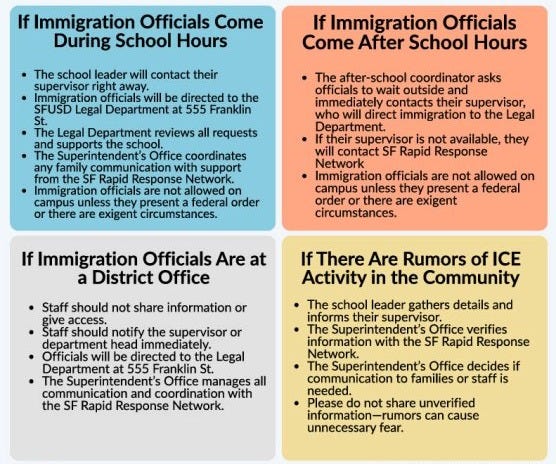
Each school I visited had big signs up about ICE, and clear instructions for staff about what do if immigration agents show up at the school door.

Articulating An Alternative Vision
Everyone from Alexandria Ocasio-Cortez to Joe Rogan agrees that the brutal techniques being used by ICE in Minneapolis need to end. But I think we should go beyond criticizing that campaign and agency, and start to more clearly articulate what immigration policies we would like to see.
On a recent New York Times Opinions podcast, Michelle Goldberg made the case for reclaiming pride in the idea that America is a land of immigrants:
“I just think it’s the best thing about America, quite simply. It’s the thing that we have historically done better than others. We absorb immigrants. We integrate immigrants. I still am very sentimental about the Emma Lazarus poem on the Statue of Liberty. Historically, we’ve gone through these periods of racial nationalism like we’re in right now, where people want to define America as an ethnic community, and periods of civic nationalism where America is about ideas and values that are open to anyone who is willing to do the work of embracing them.”
I think we should be having big, broad conversations about immigration, and I’d love to see teenagers participating in those discussions. Some things to talk about:
How hard do you think it should be for people to come to the U.S. to work?
How hard do you think it should be for people to become U.S. citizens?
How welcoming do you think we should be to people who are fleeing war or violence?
How welcoming do you think we should be to people who say they want better economic opportunities for themselves and their families?
How big of a priority do you think border and immigration enforcement should be in the federal budget?
Do you think we should give amnesty to undocumented people who are already living in the United States, like Ronald Reagan did in 1986, or lay out some other pathway to citizenship?
Do you think we should provide specific protections for people who were brought to the U.S. as children, like Deferred Action for Childhood Arrivals (DACA)?
Canada welcomes three times more immigrants on a per capita basis than then the U.S. Do you see anything in Canada’s immigration policies and goals that you think the U.S. should adopt?
Lessons From The Past
History teacher Jenna Vandenberg recently wrote about the hope she found in a visit to Ellis Island:
Once upon a not-so-long-ago time, the USA quickly and efficiently processed millions of immigrants. Ellis Island processed 12 million immigrants between 1892 and 1954. Over a million entered the United States in 1907 alone. Most immigrants arriving at Ellis Island were processed in a few hours. No passports, visas, or papers were needed to enter the United States through Ellis Island.2 For most people, getting through Ellis Island took only about 3 - 5 hours. And then they were off to their new lives in America.
When I tell this to my students, many of whom have helped their families sort through piles of immigration paperwork, their mouths drop open in flabbergastment.3
Those who say things like “immigrants today need to follow the rules, just like my ancestors did,” generally have no idea what they are talking about.
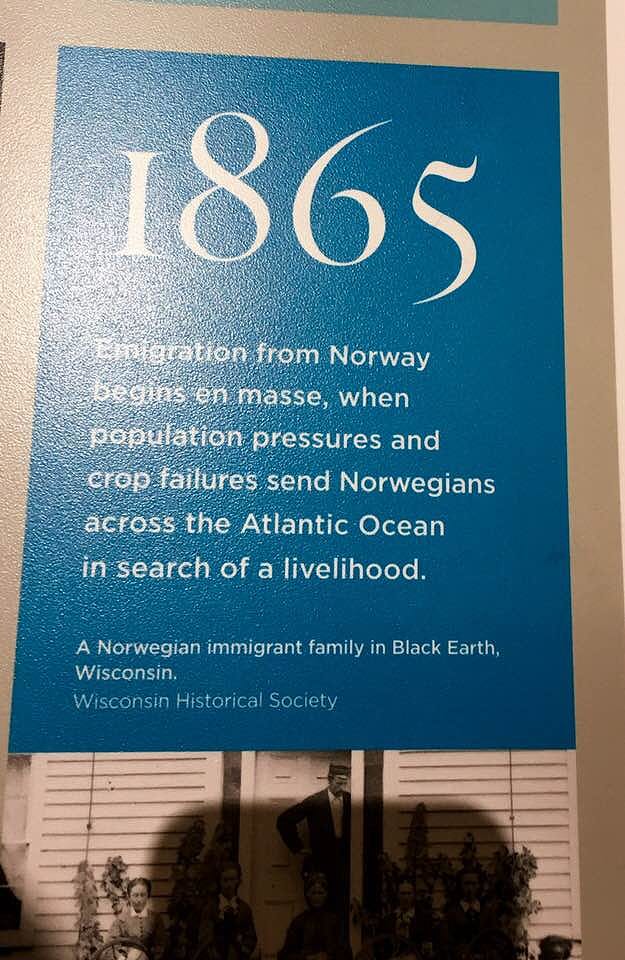
I’ve been to Ellis Island myself, and paid particular attention the exhibit on Norway, where I took the photo above.
My family roots are in Norway. In the 1800s, things were pretty rough there, and like a lot of Norwegians, they came to the U.S. to escape poverty and famine, with hopes for a better life.
Even back then, immigration didn’t sit well with everyone in the U.S., according to this Washington Post story:
“For the vast majority of their shared history, including the period in the mid- to late 1800s and early 1900s that comprised the biggest wave of immigration to the United States, Norway might have been on the president’s so-called manure pile.
European immigrants of that time fueled many of the same fears about immigration we see today, and politicians fought to close the nation’s borders back then as successive waves of migrants from different European countries faced hostility upon arrival in the United States.
Today, those immigrants are idealized as a fast-assimilating group that came over with nothing but the shirts on their backs, and handed their children the American Dream. Some place them in sharp contrast to what they see as the insular communities of present-day immigrants such as those called out by the president. But it only appears that those migrants assimilated quickly because past economists only looked at a moment in time, instead of following individuals throughout their lives.”
Despite the challenges, I am so grateful that the United States made room for my ancestors, and made it possible for us to build a life here.
I appreciate the many immigrants who help make my community vibrant and wonderful, and I want our country to keep making space for newcomers and refugees. Warmly welcoming people who want to come here seems a lot more likely to produce a positive, bright future for our country than walls, bans, or raids.
Catching Up And Lending Support
I know there is a lot of news coming out of Minneapolis. If you haven’t been following things closely and want to catch up, listen to this episode of The Daily podcast, On The Frontline Of Minnesota’s Fight With ICE, or check out the ongoing coverage from Minnesota Public Radio.
If you feel inspired to support the people on the ground, Wisconsin-based organizer Garrett Bucks is collecting love letters to Minnesota and Stand With Minnesota is providing an excellent vetted directory of places to donate.
Recent Teen Health Today Highlights
Why Is Nicotine Use Being Normalized?
Products like Zyn are bringing nicotine back into mainstream use. What’s really going on?
Every Middle School Needs A Health Class
Tweens and teens deserve real information about their brains and bodies
Michael Pollan Takes On The New Food Pyramid
The “Omnivore’s Dilemma” author would like a word. PLUS: Why is smoking making a comeback with Gen Z?
Raising Teens Today - A Roundtable Discussion
Todd Kashdan, Joanna Schroeder, and Christopher Pepper in conversation
How To Become A “Trusted Adult” For Teens
Great tools for getting better at talking about substance use
If you enjoyed this post, please forward it to someone else who might like it, and click the ❤️ or 🔁 button on this post so more people can discover it on Substack. 🙏🏼