



Reflections On My First Strike
At the end of her recent post about finding joy, Anya Kamenetz asks “what’s bringing you joy right now?”
For me, my answer is something unexpected: memories of marching on a picket line with my coworkers. Schools were closed all last week because the labor union I’m a member of, United Educators of San Francisco, was on strike. It was a new experience for me (and almost everyone else involved) and I learned a lot.
When I finished college in the late 1990s with a journalism degree, I immediately started working as a writer and editor. However, after about five years I had to change tracks because the newspaper and magazine industries started to collapse and jobs were disappearing. That’s when I started teaching high school health education in San Francisco public schools, where I’ve now been for more than two decades. I love my work.
I’ve always been happy that my teaching job is unionized, which means I have a solid retirement plan and strong job protections (important when you teach about topics that are often at the center of culture wars!)

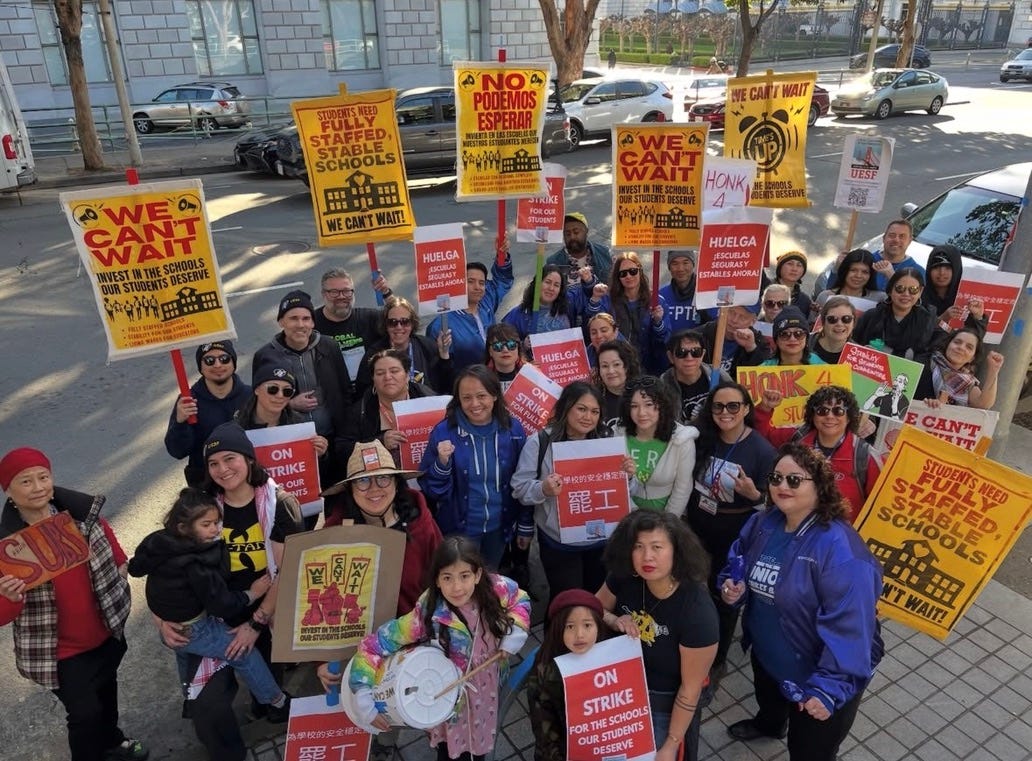
Our union renegotiates a contract with the school district every couple years, and they’ve always worked things out — in fact, before last week our union hadn’t been on strike for almost 50 years.
This time around, however, bargaining didn’t proceed as smoothly, and our union started to let us know that we might have to step up the pressure for a fair contract, and that we might even have to go on strike. This included doing a lot of education for members.
One of the FAQ sheets they distributed started with this:
Q: HOW DOES A STRIKE WORK?
A: You will show up at your school site each morning and disrupt normal school operations by picketing with your colleagues. We may hold citywide rallies during the day which you must attend. You don’t get paid for the days you strike. You cannot use sick leave, personal leave, or vacation time.
This kind of clear messaging was necessary, because almost none of the 6,500 members of our union had ever been part of a strike before. To get people ready for this possibility, the union held practice pickets and a weekend “strike school” for volunteer leaders. The plan was spelled out - if a strike was necessary, we would have active picket lines at every single school, and then come together later in the day for rallies and marches.
Our negotiation team was made up of teachers, counselors, social workers, and paraprofessionals who agreed to come to bargaining sessions in addition to working their day jobs. When it started to seem like a strike might really happen a whole other set of volunteers stepped up to be “strike captains” at each site, willing to lead chants and rally their co-workers on the line each day.
Families Were On Our Side
If you’re wondering why the district didn’t get serious about negotiating when they saw all this strike preparation happening, I recommend reading Joe Eskenazi’s in-depth article “SFUSD Fumbled The Teachers’ Strike” in Mission Local.
As he explains, although there was some grumbling online about the strike, once it started that sentiment wasn’t reflected on the ground.
“If you visited the actual school picket sites — and Mission Local reporters criss-crossed the city all week, covering protests at schools, large rallies, and even giant human messages at Ocean Beach — they were high-energy, positive and well-attended, with many families and students present and drivers honking loudly in support. Of course, not every public-school family supported an agonizing work stoppage, but the people who were backing the teachers were a lot more active and visible than the people who weren’t.”
That fits with my experience - our picket lines were boisterous, angry, and fun. My crew was in front of the school district headquarters, so we ended up on the news a lot, and it was sometimes hard for them to do interviews because it was so loud - the air filled with drums, maracas, chants, and car horns. Many of my co-workers brought their children, and multiple other unions marched with us as well.
This Brought Us Together
I have to say I did not expect striking would be such an athletic event - we walked over 20,000 steps each day of the strike - and I did not expect it would feel so connected. Our small group got very tight - as I told some people, it seemed like the best teambuilder we have ever done!
We were active and loud together, but also shared quieter moments where we exchanged stories about how we came to education and what our jobs meant to us, as well as talking about our families and lives outside of work. It was a special kind of bonding time that we don’t often have.
And when we joined all together in the afternoon, with strikers from around the city coming to one location, it was tremendous. One day we had a rally in Dolores Park and then marched all the way to City Hall, thousands strong, with neighbors cheering us on the whole way.
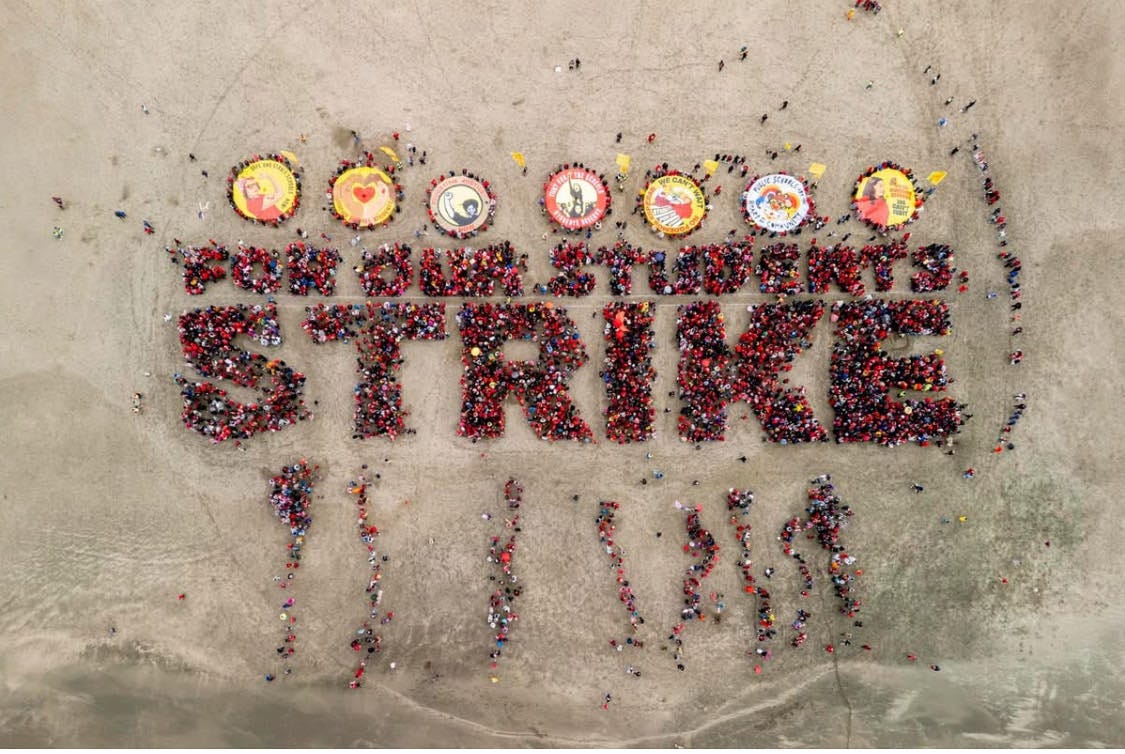
Another day we headed out to Ocean Beach and made a giant human banner together, photographed by a drone from above.
My favorite day was Thursday, when the sun finally came out and we joined our bargaining team in shouting “FIGURE IT OUT!” to district leaders, and then had a massive, street-closing march down Market Street, San Francisco’s main drag. It was like a spontaneous parade that shut down the whole downtown. Along the way, I saw so many people I knew - colleagues from other schools, former students, retired teachers, and community members.
I wasn’t the only one who felt the joy - teacher Vanessa Hutchinson-Szekely wrote a whole essay called “On the Picket Line, I Rediscovered the San Francisco That I Love.” I couldn’t agree more.
I don’t want to have to go on strike just to find this sense of community again, but I think there are lessons to be learned here about how good it feels to stand up for one another and speak loudly for fair treatment. We all recognized how much power people have when they push together for a shared cause. I want to remember that.
EXTRA: A Few Of My Favorite Picket Line Chants:
ONE: We are the people
TWO - A little bit louder
THREE - We want safety for our students!
Say it loud! Say it Clear!
Immigrants are welcome here!
And, and the strike continued…
One day longer
ONE DAY STRONGER!
Recent Teen Health Today Highlights
My Dad Just Died. He Would Want You To Gather.
Lessons from a very connected life
Some Teachers Are Determined To Keep AI Out Of Their Classrooms
Concerned that AI may discourage deep thinking, some teachers going analog
W. Kamau Bell - The Teen Health Today Interview
The Emmy-award winning comedian explains how laughter can help fight ignorance and build community
Let’s Really Talk About Immigration
Does America still welcome the “huddled masses yearning to breathe free”?
This was such an inspiring read! And an incredible example for others across the country. We won't really have capacity as a country to do a real "general strike" in protest of major injustices unless childcare providers, and the families they serve, are able to figure out how to work in solidarity with one another, in organized and joyful ways.
I loved reading this bc our faculty also just authorized a strike authorization--which would be my irst strike! the possibility feels scary and exciting. I'm relieved to hear that it was a positive experience for you.